GST/HST Invoice Requirements in Canada: CRA Rules
What a Canadian GST/HST invoice must show: the $100 and $500 tiers, your GST/HST number, which rate to charge by province, and a worked example.
A Canadian GST/HST invoice needs your business name, the invoice date and the total. From $100 it must also show your GST/HST registration number and the tax amount, or a statement that tax is included. From $500 it adds the customer's name, the payment terms and a description of each item.
Last reviewed: 23 October 2026 against CRA guidance and the Input Tax Credit Information (GST/HST) Regulations.
Who must charge GST/HST
You have to register for GST/HST once you stop being a small supplier and you make taxable sales in Canada. The small supplier limit for most businesses is $30,000 of taxable sales, and the CRA applies it in two ways (When to register):
- More than $30,000 in a single calendar quarter: you stop being a small supplier with the sale that takes you over, and you charge GST/HST on that sale.
- More than $30,000 over four consecutive calendar quarters, but not in one quarter: you stop being a small supplier at the end of the month after the quarter in which you went over. You charge tax from your first sale after that.
Either way, you have 29 days from your effective date of registration to register. Charities, public institutions and other public service bodies have their own tests, including a $50,000 limit. Below the limit you can still register voluntarily, and self-employed taxi and commercial ride-sharing drivers must register even if they are small suppliers (Taxi and ride-sharing drivers).
When you register, your GST/HST number is your 9-digit business number followed by the program code RT and a 4-digit reference, for example 123456789 RT 0001 (CRA program account numbers).
Why the rules are about your customer's input tax credits
Canada has no single law that sets out an invoice layout. The list of required details comes from the Input Tax Credit Information (GST/HST) Regulations, which say what a business needs on its paperwork to claim back the GST/HST it paid. Those claims are called input tax credits, or ITCs.
In practice, your invoice is your customer's evidence. If a business customer receives an invoice without your GST/HST number, they don't have what they need to support an ITC for the tax you charged them. That is why the details grow with the invoice total: the larger the amount, the more the CRA wants to see before it gives the tax back.
The invoice has to show the applicable GST/HST rate, and whether the tax is added to the price or included in it. Where HST applies, show only the combined HST rate, such as 13%, never the federal and provincial parts separately. All of this exists so your customer can support their input tax credits.
What your invoice must show at each amount
The tier depends on the total amount paid or payable shown on the invoice:
| Invoice total | Required details |
|---|---|
| Under $100 | Your name or business name, the invoice date, and the total amount paid or payable. |
| $100 to under $500 | Everything above, plus your GST/HST registration number; the GST/HST amount for each item or for the whole invoice, or, if prices include tax, a statement saying so with the total tax rate; and, when items have a different tax status, which ones are taxable. |
| $500 or more | Everything above, plus the customer's name or business name (or their authorized agent's), the terms of payment, and a description of each item clear enough to identify it. |
A simple checklist covers all three tiers. If your template always has these, you never need to think about the thresholds:
- Your business name and GST/HST number.
- The invoice date.
- Your customer's name.
- A description of each item.
- The GST/HST rate and amount.
- The total.
- The payment terms.
Which GST/HST rate to charge
The rate depends on what you sell, who you sell to, and where the supply is made (GST/HST rates). The CRA's current rates:
| Province or territory | Tax | Rate |
|---|---|---|
| Alberta, Northwest Territories, Nunavut, Yukon | GST | 5% |
| British Columbia, Manitoba, Saskatchewan, Quebec | GST (plus a separate provincial tax) | 5% |
| Ontario | HST | 13% |
| Nova Scotia (from 1 April 2025) | HST | 14% |
| New Brunswick, Newfoundland and Labrador, Prince Edward Island | HST | 15% |
Nova Scotia's rate was 15% until 31 March 2025. Zero-rated supplies, such as basic groceries, are taxed at 0% everywhere in Canada.
"Where the supply is made" is the place of supply, and it is often not where your business is. For goods, it is generally the province where they are delivered. For most services, the general rule uses your customer's home or business address in Canada. The CRA's own example: a Quebec business designs a website for an Ontario company, does all the work in Quebec, and charges Ontario's 13% HST because the client's business address is in Ontario. Some services have their own rules, including personal services, services related to real property and services at a specific event, so check the place-of-supply rules when a sale crosses provincial lines.
Worked example: an Ontario HST invoice
A fictional sole proprietor, Maplegrove Web Studio (GST/HST no. 123456789 RT 0001, the CRA's sample number, example only), bills a fictional Ontario company, Lakeshore Example Inc. Invoice INV-2026-027 was issued on 23 October 2026 with Net 30 terms. The client's business address is in Ontario, so 13% HST applies, and the total is over $500, so the customer's name, payment terms and item descriptions are all on the invoice. Amounts appear exactly as Invoice Builder prints them.
| Qty | Description | Unit price (excl. HST) | Net | HST rate | HST |
|---|---|---|---|---|---|
| 20 h | Website development | CA$ 85.00 | CA$ 1,700.00 | 13% | CA$ 221.00 |
| 1 | Website maintenance (12 months) | CA$ 300.00 | CA$ 300.00 | 13% | CA$ 39.00 |
| Subtotal excluding HST | CA$ 2,000.00 | ||||
| HST 13% | CA$ 260.00 | ||||
| Amount due | CA$ 2,260.00 | ||||
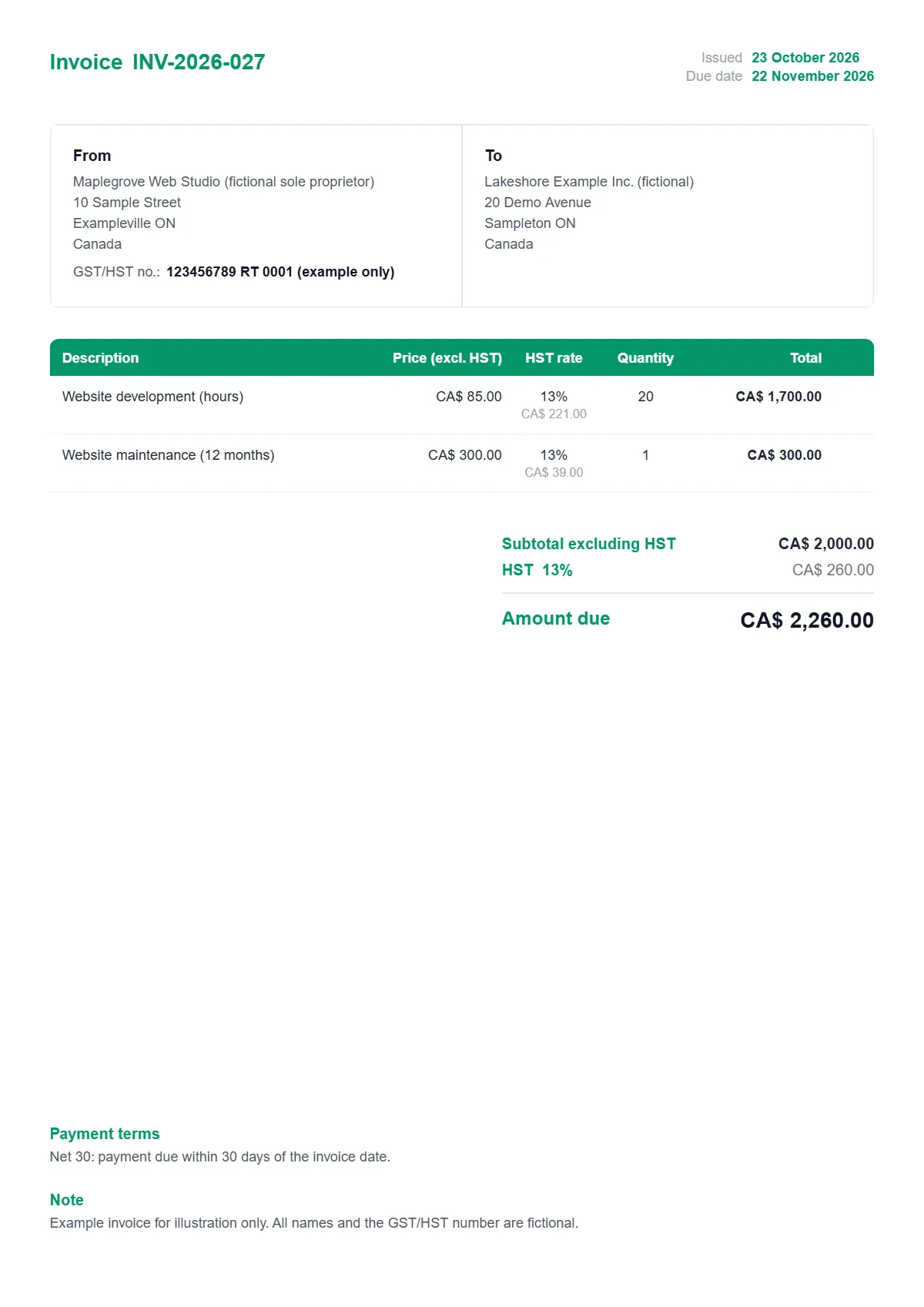
Download the example GST/HST invoice (PDF), built with Invoice Builder.
To set up Invoice Builder for Canadian invoices once:
- Choose CAD (CA$) as the currency.
- Click each label to rename it: INVOICE to Invoice, VAT / Tax ID to GST/HST no., Price (excl. VAT) to Price (excl. HST), VAT rate to HST rate, Subtotal excluding VAT to Subtotal excluding HST, and VAT to HST. In a GST-only province, use GST instead of HST.
- Set the rate on the first line, for example 13% for Ontario. New lines copy the rate of the line above.
- Rename Terms & conditions to Payment terms and write your terms there, for example "Net 30". The due date prints at the top.
- Keep Remember my settings switched on, so new invoices start with your labels, currency and rate.
Two limits to know: prices are entered before tax, so the tool can't print tax-included prices with a tax-included statement, and each line carries one tax rate.
Provinces with PST or QST
In British Columbia, Manitoba and Saskatchewan, many sales carry the 5% GST plus a separate provincial sales tax of 7%, 7% and 6%. In Quebec, the 5% GST sits alongside the 9.975% Quebec sales tax (QST), which Revenu Québec administers. Calculate GST on the price without the provincial tax. PST rules come from each province, and QST from Revenu Québec, so check them there before invoicing.
Invoice Builder handles one tax per line. That works for GST-only and HST invoices, but it cannot show GST and PST, or GST and QST, as two taxes on the same line. If your sales carry a provincial tax as well, use software that supports two taxes per line for those invoices.
Before writing this, I checked every requirement against the actual regulation (SOR/91-45, s.3), not summaries of it. The tiers surprised me: below $100 your GST/HST number isn't required at all, but from $500 your customer's name and payment terms are. I also confirmed Invoice Builder's numbers line by line ($300.00 × 13% = $39.00). Where it falls short (two taxes on one line, tax-included prices), I've said so above rather than hide it.
Common Canadian invoice mistakes
- No GST/HST number from $100. Without it, your business customers can't claim their input tax credits.
- Charging your own province's rate. The rate follows the place of supply, which for most services is the customer's address.
- Missing payment terms or customer name from $500. Both become required at that amount.
- Tax-included prices without saying so. If the total includes tax, the invoice has to say so and give the total tax rate.
- Splitting HST into federal and provincial parts. Show the single HST rate.
How other countries compare: see UK VAT invoice requirements, Australian tax invoice requirements and US invoice requirements. For the general picture, read the VAT invoice guide. Keep your invoices and other GST/HST records for six years from the end of the last year they relate to; the CRA can ask for longer.
Create a GST/HST invoice free
Set CA$ and your province's rate once, add your GST/HST number and payment terms, and export a PDF invoice. No signup required.
Create a GST/HST invoice freeFrequently asked questions
Do I need to show my GST/HST number on every invoice?
It is required once the invoice total reaches $100. Below $100, the rules only ask for your name, the date and the total, so the number is optional. Showing it on every invoice is simpler: one template covers all amounts, and customers who check your registration in the CRA's GST/HST Registry have the number to hand.
What changes on invoices of $500 or more?
Everything required from $100 still applies: your name and GST/HST number, the date, the total, and the tax amount or a tax-included statement. From $500 the invoice must also show your customer's name (or business name), the terms of payment, and a description of each item clear enough to identify it.
Which rate do I charge a client in another province?
The rate follows the place of supply, not where your business is. For most services, that is generally the province of the customer's home or business address in Canada; for goods, it is usually where they are delivered. A Quebec designer working for an Ontario company charges Ontario's 13% HST. Some services have their own rules, so check the CRA's place-of-supply page.
Do I charge GST/HST if I'm a small supplier?
Not if you stay a small supplier: $30,000 or less in taxable sales over four consecutive calendar quarters, and not more than $30,000 in a single quarter. You can register voluntarily. Self-employed taxi and commercial ride-sharing drivers are the exception: they must register even as small suppliers.
How long must I keep invoices?
Usually six years from the end of the last year the records relate to, and the CRA can ask you to keep them longer. That covers the invoices you issue and the ones you receive, since your records must support the GST/HST you collected and the input tax credits you claim.
Ready to Create Your Invoice?
Start generating professional invoices in seconds — completely free, no signup required.
Create Free Invoice NowNo account needed · Export to PDF · 100% free