UK VAT Invoice Requirements: What HMRC Requires
What a UK VAT invoice must show under HMRC rules: full, simplified and modified invoices, the £250 limit, deadlines, and a worked example.
A UK VAT invoice must show your VAT registration number, the time of supply (tax point), the customer's name and address, each line's net amount and VAT rate, and the total VAT in pounds sterling. For sales of £250 or less including VAT, HMRC allows a shorter simplified invoice.
Last reviewed: 13 October 2026 against HMRC guidance on GOV.UK.
Who must issue a VAT invoice (and when)
Only a VAT-registered business can issue a VAT invoice. If you are not registered, send an ordinary invoice and do not charge VAT. Registration becomes compulsory when your taxable turnover passes £90,000 over the last 12 months, or when you expect it to pass that figure within the next 30 days (Register for VAT). Businesses based outside the UK that supply goods or services here may have to register whatever their turnover; see VAT Notice 700/1.
Once registered, you must give a VAT invoice whenever you make a standard-rated or reduced-rated supply to another VAT-registered business. HMRC expects it to be issued within 30 days of the time of supply in most cases (VAT Notice 700/21).
Paper and electronic invoices are both acceptable today; the conditions for electronic ones are in VAT Notice 700/63. The government has also confirmed that e-invoicing will become mandatory for all VAT invoices from 2029, covering business-to-business and business-to-government sales, with an implementation roadmap promised at Budget 2026 (consultation response). No start month or technical standard had been published when this article was reviewed.
What a full UK VAT invoice must show
Under section 4.1 of Notice 700/21, a full VAT invoice needs:
- A unique invoice number that follows a sequence (you may run more than one series).
- The time of supply, also called the tax point.
- The date of issue, if it differs from the time of supply.
- Your business name, address and VAT registration number.
- Your customer's name and address.
- A description clear enough to identify what you supplied.
- For each line: the quantity of goods or extent of the service, the VAT rate, and the amount excluding VAT.
- The unit price.
- The total amount excluding VAT.
- The rate of any cash (prompt-payment) discount you offer.
- The total VAT charged, shown in pounds sterling.
Net amounts may be in any currency; only the VAT total has to be in sterling.
What changed in March 2024: HMRC's update of 18 March 2024 removed "the reason for any zero rate or exemption" from the list of required details. Many older checklists still include it. You can add a short explanation if it helps your customer, but its absence no longer makes an invoice invalid.
Full vs simplified vs modified invoices
| Invoice type | When you can use it | Key difference |
|---|---|---|
| Full | Any taxable supply to a VAT-registered customer | Every detail listed above, with net values per line |
| Simplified | Total charge of £250 or less, including VAT | No customer details or per-line net amounts; shows the VAT-inclusive total and rate for each VAT rate. Exempt supplies not allowed |
| Modified | Charges over £250 when the customer asks for an invoice | Shows values including VAT instead of excluding VAT |
To choose:
- Is the total charge £250 or less including VAT, with no exempt items? A simplified invoice is enough.
- Over £250 and your customer has asked for an invoice? Issue a full invoice, or a modified one if VAT-inclusive prices suit your business.
- Anything else to a VAT-registered customer? Issue a full invoice.
Simplified-invoice example: a £180.00 sale at the 20% standard rate contains £30.00 of VAT, because £180.00 ÷ 1.2 = £150.00 net (Charge, reclaim and record VAT). The invoice shows £180.00, the 20% rate, and the other simplified details.
Worked example: a UK VAT invoice line by line
Here is a full invoice from a fictional web designer, Northfield Web Design Ltd, to a fictional client, Brightway Example Ltd. The VAT number is GB 123 4567 89 (example only). Invoice INV-2026-041 has a time of supply of 30 September 2026 and was issued on 2 October 2026, within the 30-day window.
| Qty | Description | Unit price (ex VAT) | Net | VAT rate | VAT |
|---|---|---|---|---|---|
| 12 h | Website design | £55.00 | £660.00 | 20% | £132.00 |
| 1 | Hosting setup | £120.00 | £120.00 | 20% | £24.00 |
| 2 | Printed style guide (book) | £20.00 | £40.00 | 0% | £0.00 |
| Net total | £820.00 | ||||
| VAT | £156.00 | ||||
| Total payable | £976.00 | ||||
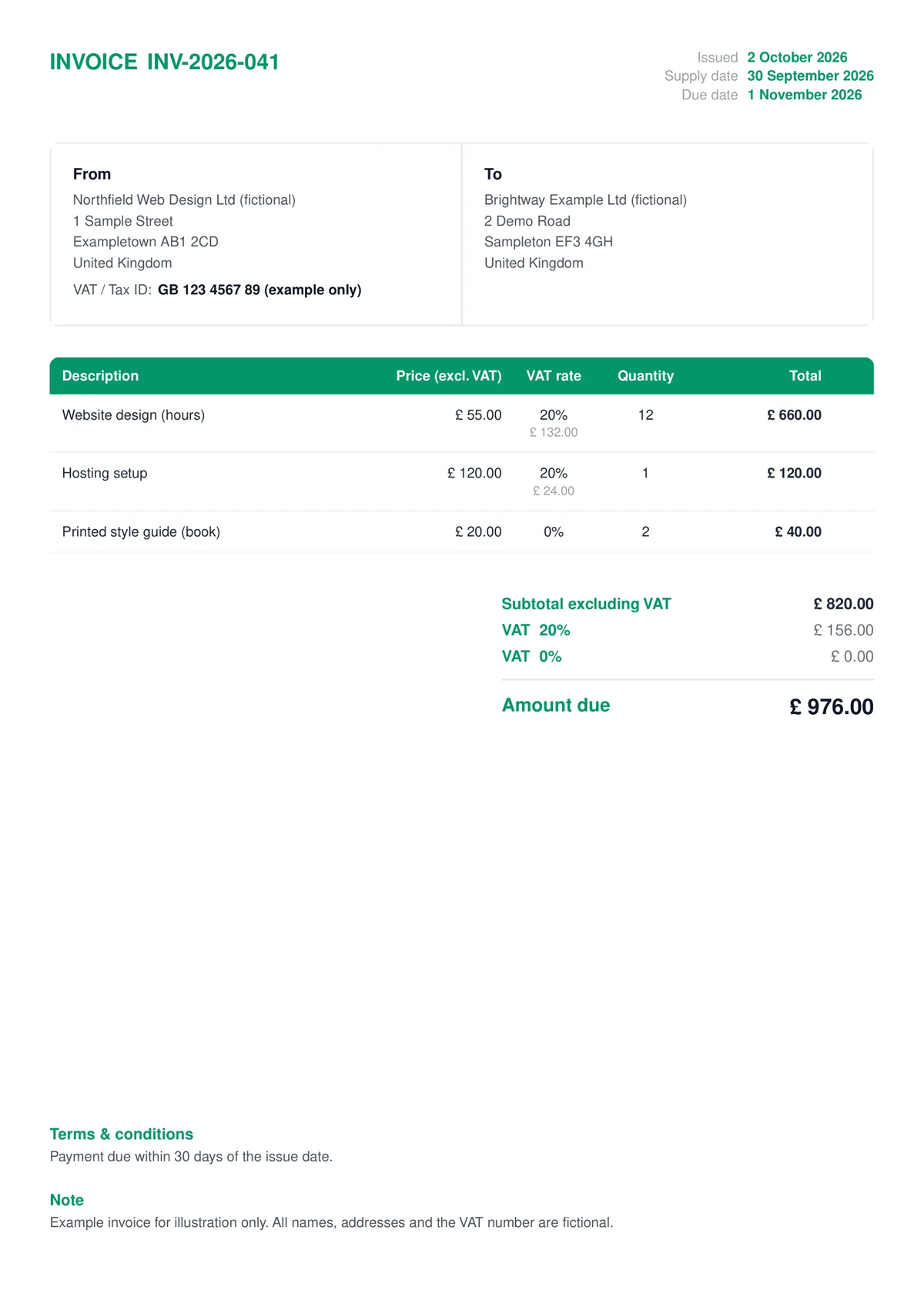
The £156.00 of VAT is 20% of the £780.00 standard-rated base; the zero-rated line adds no VAT.
The printed book is zero-rated (subject to the conditions in VAT Notice 701/10), but it still appears on the invoice at 0%. Zero-rated sales are taxable supplies, so they belong on a VAT invoice alongside standard-rated lines.
Download the example invoice (PDF), built with Invoice Builder.
How the fields map in Invoice Builder:
- Supply date holds the time of supply (tax point); Issued holds the date of issue.
- VAT / Tax ID, under your details, holds your VAT registration number.
- Each line takes a net unit price and its own VAT rate, including 0%, and the totals show VAT separately for each rate.
Three things need a workaround:
- Early-payment discount: there is no field for a cash-discount rate, so state it in your payment terms, for example "2.5% discount if paid within 10 days". The Discount field is for a reduction you are actually giving; it is applied before VAT is calculated.
- Delivery charges: the Shipping field is added after VAT and is never taxed. If your delivery charge carries VAT, add it as a normal line item with the appropriate rate instead.
- Foreign-currency invoices: see the next section.
Invoicing in a foreign currency
You can price an invoice in US dollars, euros or any other currency, but the total VAT must also be stated in sterling. VAT Notice 700, section 7.6 sets out how to convert it:
- Default: use the UK market selling rate at the time of supply. Rates published in national newspapers are acceptable evidence.
- HMRC period rates: you may instead use HMRC's period rates for customs purposes, for all your supplies or one class of them. You don't need to tell HMRC first, but once adopted you need its written agreement to switch.
- Your own commercial rate: any other rate or method needs HMRC's approval in writing. Forward rates are not accepted.
Whichever basis you use, apply the rate current at the time of each supply.
Invoice Builder shows amounts in one currency only. If you invoice in a currency other than GBP, convert the VAT total yourself and write it in the Notes field, for example: "VAT total in sterling: £156.00 (converted at the UK market selling rate on 30 September 2026)".
When you don't need a VAT invoice
Section 4.6 of Notice 700/21 lists four situations where no VAT invoice is required:
- Your customer runs a self-billing arrangement, or you issue authenticated receipts.
- You give away goods as a gift on which VAT is due.
- You sell goods under a second-hand margin scheme.
- The invoice covers only exempt or zero-rated sales within the UK.
Retailers also don't need to issue VAT invoices to customers who aren't VAT registered, unless the customer asks. Margin-scheme and reverse-charge invoices follow special rules; check the notice before using either.
Common UK VAT invoice mistakes
- No time of supply. An issue date alone is not enough when the supply happened on a different day.
- VAT total only in a foreign currency. The sterling figure is mandatory.
- Exempt items on a simplified invoice. Use a full invoice instead.
- Charging VAT before you are registered. You cannot show VAT or a VAT number until HMRC registers you.
- Gaps or duplicates in numbering. Each invoice needs a unique number from a sequence.
- Discarding copies too early. Keep VAT records for at least six years.
A note from building this tool: when I checked Invoice Builder against HMRC's rules while writing this guide, I found it was working out VAT on the full amount and only then subtracting the discount. On a £100 job at 20% VAT with a 10% discount, that produced a total of £110 instead of the correct £108 (£90 net plus £18 VAT). It's an easy mistake to miss because the invoice still looks right at a glance. I fixed it, and the tool now applies discounts before calculating VAT, splitting an invoice-level discount across lines so mixed VAT rates stay correct. If you calculate invoices by hand or in a spreadsheet, check this order of operations: discount first, then VAT.
For the fields every invoice needs, VAT or not, see what to include on an invoice. For how VAT invoices work in other countries, read the VAT invoice guide. To compare with a GST system, see Australian tax invoice requirements or GST/HST invoice requirements in Canada. For a country with no VAT or GST at all, see US invoice requirements.
Create a UK VAT invoice free
Add your VAT number, the supply date and a VAT rate per line, including 0%, then export a PDF. No signup required.
Create a UK VAT invoice freeFrequently asked questions
Do I need to issue a VAT invoice to consumers?
Usually not. The obligation applies to standard- or reduced-rated sales to other VAT-registered businesses. Retailers selling to unregistered customers only have to provide one if the customer asks. In that case a simplified invoice is fine for £250 or less including VAT, and a full or modified invoice is needed above that.
How long do I have to issue a VAT invoice in the UK?
HMRC expects you to issue a VAT invoice within 30 days of the time of supply in most cases. Payment terms are a separate matter: you can give your client longer to pay, but the invoice itself should still go out on time.
Can I issue a UK VAT invoice in dollars or euros?
Yes. Line prices and the net total can be in any currency, but the total VAT must also be stated in pounds sterling. Convert it using the UK market selling rate at the time of supply, or another basis HMRC accepts under VAT Notice 700, and apply the rate that was current on the date of that supply.
What is the limit for a simplified VAT invoice?
You can use a simplified VAT invoice when the total charge is £250 or less, including VAT. It needs fewer details: your name, address and VAT number, the time of supply, a description, and the VAT-inclusive total and rate for each VAT rate. It cannot include exempt supplies, and customer details are not required.
How long must I keep VAT invoices?
Keep VAT invoices, both the copies you issue and the ones you receive, for at least six years. Other taxes can require longer, so many businesses simply apply the longest period across all their records. Treat six years as the minimum, not the target.
Ready to Create Your Invoice?
Start generating professional invoices in seconds — completely free, no signup required.
Create Free Invoice NowNo account needed · Export to PDF · 100% free